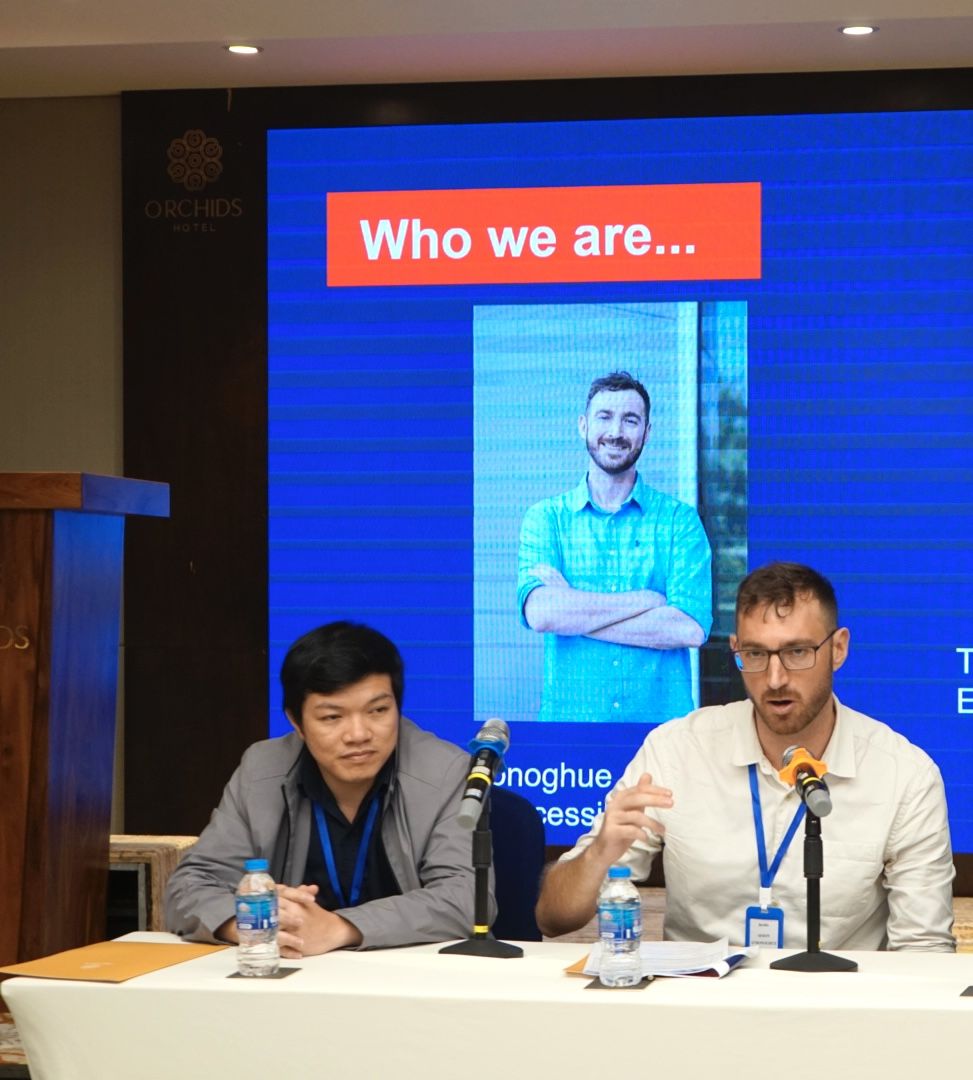


The “Employment Bridge – Accompanying Employers and People with Visual Impairments” conference, organised by Sao Mai for the Blind with support from The Nippon Foundation, was not only a space to connect employers with people with visual impairments, but also an opportunity to discuss what is needed to build inclusive workplaces. In this context, the presentation from RMIT Vietnam focused directly on an issue that is very practical for employers: reasonable adjustments in workplaces that employ staff with visual impairments, and the specific benefits these adjustments can bring to organisations.
Speakers
The two speakers from RMIT University Vietnam were Mr Simon O’Donoghue, Advisor for Diversity, Equity and Inclusion, and Mr Nguyen Minh Tuan, Outreach Specialist, who is also a staff member with visual impairment working in an inclusive environment at RMIT. From two different positions – one in charge of designing and implementing policies, and one directly experiencing that environment every day – they offered a comprehensive picture: what “reasonable adjustments” mean in practice, why businesses are often hesitant, and how, when implemented properly, reasonable adjustments can unlock the potential of employees with visual impairments and add value to the organisation itself.
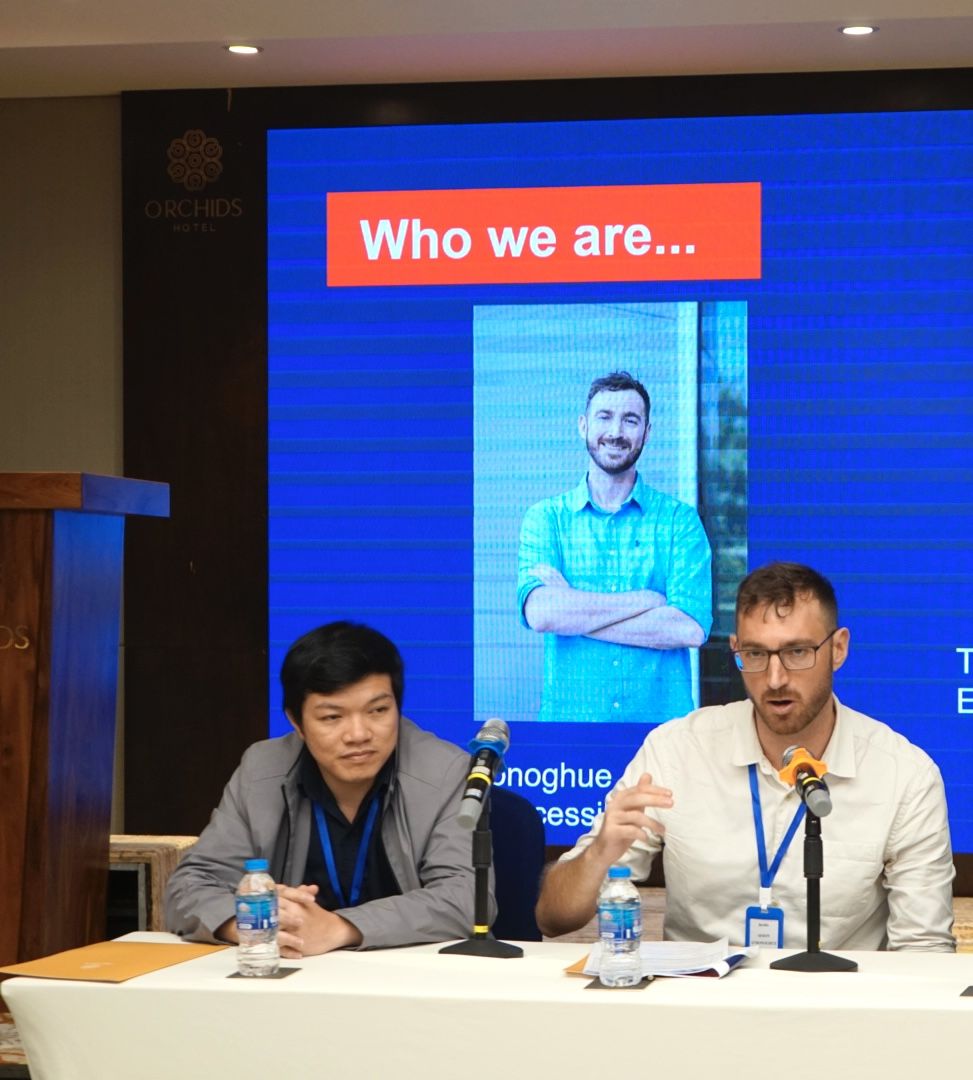
Reasonable Adjustments from a Systems Perspective
Mr Simon began by stressing that RMIT approaches disability through the social model, in which barriers mainly lie in the environment and systems, not only in the functional limitations of each individual. The role of the organisation is therefore to identify and remove these barriers so that all staff can participate and contribute on an equal basis. In this context, reasonable adjustments are understood as specific, practical changes in procedures, environment or tools that remove barriers. They are not “special favours” or privileges for a particular group.
He suggested that businesses look at reasonable adjustments through five common types of barriers: physical and environmental barriers; technological and digital barriers; attitudinal barriers and stereotypes; information and communication barriers; and barriers created by internal policies and procedures. In each group, reasonable adjustments often start from small but concrete changes, such as arranging the workspace to be easier to navigate, using documents in formats that work with screen readers, reviewing job descriptions to avoid unintentionally excluding candidates with disabilities, or adjusting internal processes so that staff with visual impairments can fully participate in common activities.
What Reasonable Adjustments Can Be Implemented?
Mr Simon emphasised that reasonable adjustments can and should be applied throughout the whole employment cycle. At the job posting stage, employers can prioritise plain text formats, limit images containing text, and avoid files that are hard to access with assistive technology. At the application and interview stage, employers can be flexible by allowing candidates to submit applications via email if the online portal is not yet accessible, provide interview materials in accessible formats, and allow candidates to use assistive devices.
Once staff are hired, companies can standardise training materials in digital text formats, combined with basic training on inclusion for the team, and assign a colleague to support the new staff member during the initial period. According to international experience as well as practice at RMIT, most of these adjustments do not require major financial investment, but mainly involve changing how systems and processes are designed and operated. When businesses invest in reasonable adjustments, not only staff with visual impairments benefit; the whole team is supported by clearer processes, easier-to-use documents and more transparent communication.
Common Concerns and Misconceptions about Reasonable Adjustments
In the next part, Mr Simon spoke frankly about the common concerns that businesses have when they start to consider hiring people with disabilities in general, and people with visual impairments in particular.
The first concern is cost. Many employers imagine that adjusting the workplace for staff with visual impairments means large investments and extensive changes. In reality, many reasonable adjustments are mainly about how information is presented, which document formats are used, or how a part of the process is organised. These changes are usually low-cost but can have a big impact.
The second concern is the fear of “doing it wrong” – worrying about offering the wrong kind of support or unintentionally using words that might upset staff. Mr Simon said this feeling is understandable, but the effective approach is not to avoid the issue, but to have open conversations. Asking candidates or staff with visual impairments directly about the barriers they face and the support they need is a key step in designing suitable adjustments.
The third concern comes from the fear of creating a sense of “special treatment”. Some managers worry that individual adjustments for a staff member with visual impairment may make other staff feel that things are unfair. Mr Simon stressed that reasonable adjustments are designed to bring everyone to the same level of access, not to give extra advantage to one person. When barriers are removed, staff with visual impairments simply have a fair chance to show the abilities they already have.
Finally, many businesses feel unsure because they “do not have a model to follow” and do not know where to start. Mr Simon’s message is that there is no need to wait for a perfect model before taking action. Companies can begin with small but consistent steps, then test, review and adjust over time. Each successful case will help to build a sustainable culture of inclusion, where hiring staff with visual impairments is no longer an exception but just a normal recruitment option like any other.
From this analysis, Mr Simon concluded that talent already exists within the disability community, but opportunities to access and demonstrate that talent are still lacking. The role of employers is to create fair access conditions so that this human potential can be fully realised.
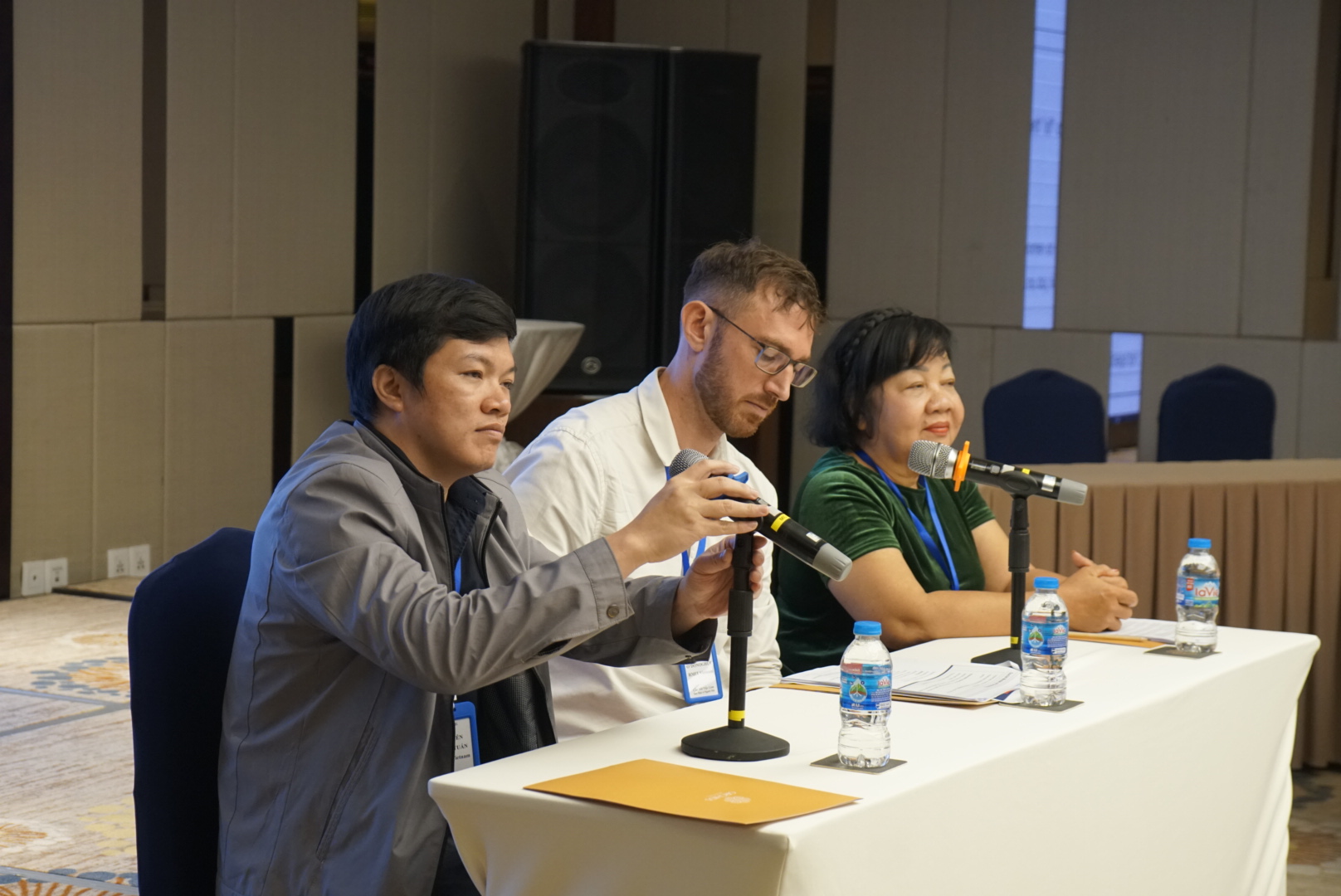
Perspective from Lived Experience
Following the systems-focused presentation, Mr Nguyen Minh Tuan shared everyday stories from the perspective of a staff member with visual impairment working in a workplace where reasonable adjustments are implemented in a systematic way. In his role as Outreach Specialist, his work involves connecting students, lecturers, internal departments and external partners to raise awareness about inclusion, diversity and equitable access.
He shared that when reasonable adjustments are implemented seriously, his working life becomes more meaningful rather than simply “easier”. Barriers do not completely disappear, but they no longer dominate all of his energy and time. Instead of constantly having to “clear the way” for himself in every small task, he can focus more on professional work such as designing activities, working with communities and contributing to his unit’s inclusion strategy.
A key point in his sharing was the role of open communication. According to him, what matters is not that the organisation understands every type of disability, but that it is willing to ask questions, listen and try solutions together. When managers and colleagues actively ask about specific barriers and how they can help, staff with visual impairments have space to express their needs honestly. In this way, reasonable adjustments become a process of co-creation, not a “support package” imposed from the top down.
With his professional experience in outreach and accessibility, Mr Tuan also showed that people with disabilities are not only recipients of support, but also an important source of expertise in building inclusive environments. Consulting people with lived experience, both as staff and as specialists, helps businesses avoid superficial adjustments and focus instead on changes that are truly needed.
Key Messages for Employers from the RMIT Experience
From Mr Simon’s analysis and Mr Nguyen Minh Tuan’s real-life experience, we can draw a clear message for employers who are interested in inclusive recruitment. Reasonable adjustments are not a financial burden, and they are not special rights reserved for one group of staff. They are the minimum conditions needed to ensure fair access for workers in a professional environment. Most reasonable adjustments start with redesigning processes, ways of sharing information and ways of organising work so that everyone can take part.
For people with visual impairments, when barriers in information, technology, environment and attitudes are removed, they can use their professional skills just like any other staff member. For businesses, investing in reasonable adjustments not only widens the pool of potential candidates but also strengthens their reputation as responsible organisations that value diversity and are willing to adapt to new demands in the labour market.
Through RMIT Vietnam’s contribution at the “Employment Bridge – Accompanying Employers and People with Visual Impairments” conference, Sao Mai wishes to send the following message to the business community: building an inclusive workplace is not an unrealistic goal. By starting with concrete and achievable reasonable adjustments, every company can help create real change for people with visual impairments, while also improving the quality of its own workforce and organisational culture.
Share via:
EmailFacebookTwitterGoogleLinkedin